
 Beyond the Broadcast: An Interactive
Regata de la Concha Powered by ENACT
The Regata de la Concha is a living part of Basque cultural heritage. On 13 September 2026, ENACT successfully validated UC2 during the live event, combining live media, boat telemetry, audience participation and an immersive 3D environment while testing adaptive edge-to-cloud operation under real-world conditions.
AT A GLANCE
Application
Interactive and immersive coverage of the Regata de la Concha.
Pilot partners
EITB for media production, Osoigo for participation and interaction, and Arctur for the 3D environment, with the support of Innovalia Association.
Live inputs
Four GPS trackers and six audio-video feeds, combined with anonymous audience interaction signals
ENACT value
Cross-platform observability and policy-driven control, with adaptive reconfiguration successfully exercised under live-event conditions.
A cultural event with a digital opportunity
Every September, the Regata de la Concha brings sport, tradition and regional identity together in San Sebastian. People experience the race from the shoreline, from boats and through EITB’s live coverage. Yet the conventional digital model remains largely passive: viewers watch the programme selected for them, with limited ability to choose a perspective, explore race data or take part in the experience.
This challenge is not unique to the regatta. Many cultural heritage events have strong physical identities but relatively static digital extensions. They may reach large audiences, but they do not always turn that reach into participation, deeper understanding or a richer tourism experience. UC2 explores how ENACT can support a different model without changing the authenticity of the event itself.
The aim is not to replace the broadcast. It is to add a responsive digital layer around it, allowing audiences to watch, explore and participate in real time.
One race, several real-time data flows
The pilot combines two main production flows. Four GPS trackers attached to competing boats provide location, speed, direction and timing data. In parallel, six live audio-video feeds are captured and encoded by EITB. These signals pass through aggregation and distribution nodes, where they can be processed and delivered to different user-facing services.
Osoigo’s platform brings the live event to web and mobile audiences, offering access to the broadcast, available camera views, polls and lightweight participation features. Arctur uses the GPS stream to render a synthetic 3D representation of the race, including a bird’s-eye view and perspectives closer to the boats. The 3D experience is designed to run on standard devices rather than requiring dedicated virtual-reality hardware.
During the live validation, these elements operated together as part of the integrated UC2 experience. The broadcast remained operational, the connection between the UC2 platform and ENACT performed as expected, and the system generated technical evidence under changing conditions and live-event pressure.
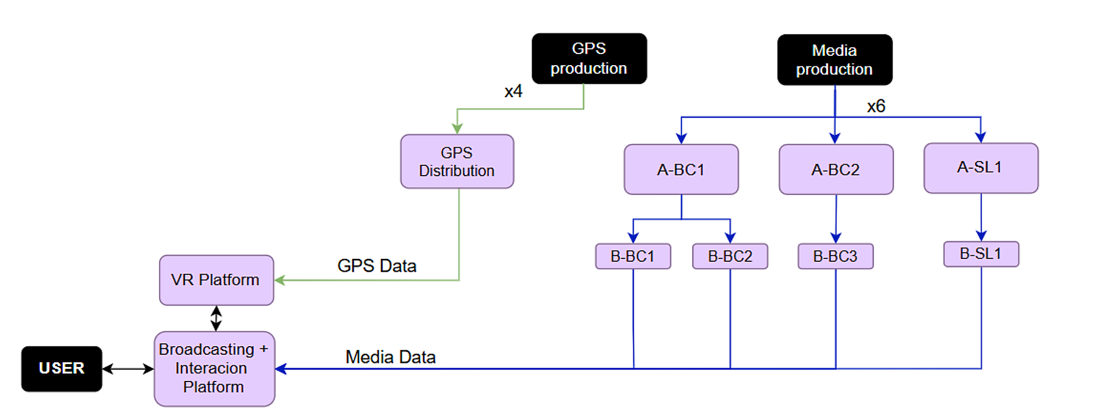
GPS and media production converge in the interactive broadcasting and 3D experience.
From spectators to participants
The most visible innovation in UC2 is the shift from a watch-only model to a participatory one. Users can choose among available views, respond to polls and move between streaming and immersive content. These features also generate anonymous, aggregated signals such as camera switches, module-level user counts and time spent in each part of the platform.
Those signals are not used to identify individuals. During the live event, visitors in Donostia-San Sebastián were able to experience the pilot first-hand, explore the 3D environment and interact with the platform, while the team gathered aggregated behavioral and technical evidence for post-event analysis.
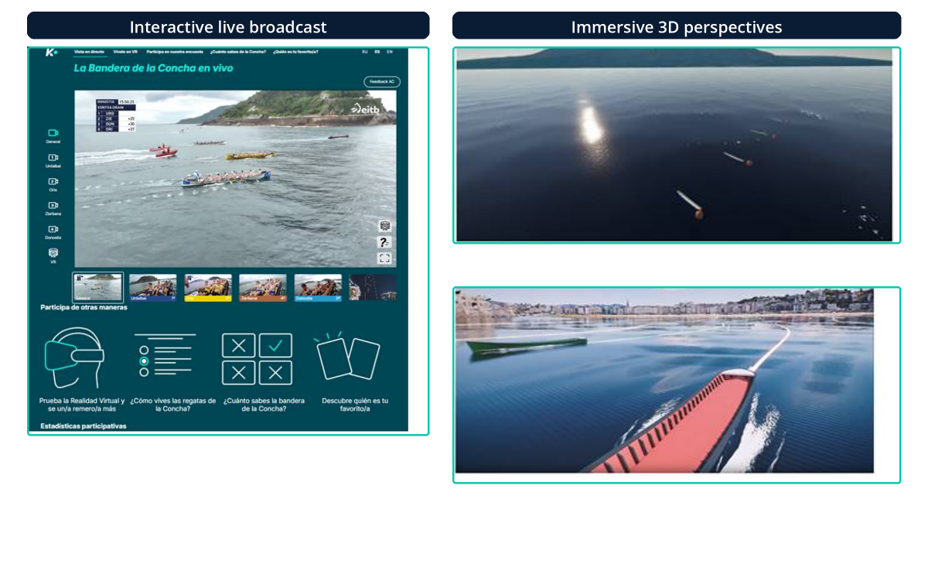
UC2 combines an interactive live platform with immersive 3D perspectives of the race.
How ENACT protects the experience
Behind the user interface, ENACT provides the control and observability layer needed to manage a distributed service. The Telemetry Data Collector and Monitoring Engine collects indicators from EITB and Osoigo, including latency, jitter, throughput, packet loss, transmission rates and inter-pod latency, together with CPU, memory and energy-related metrics. These data are made available through ENACT’s data interfaces and stored for monitoring and historical analysis.
The Application Controller checks the state of the pilot against runtime policies held in the Application Policy Model, while the Dynamic Graph Modeller visualizes the distributed topology. During the live validation, ENACT correctly identified changing conditions and generated reconfiguration recommendations. These recommendations were received and executed by DataMiner, demonstrating an end-to-end adaptation path from observation and decision support to action.
The live result turned the observe, interpret and act cycle from a target behavior into a validated operational flow. Across the two stress tests, the integrated system showed positive preliminary behavior under changing conditions, while the broadcast continued to operate successfully.
Measuring what the audience actually experiences
UC2 deliberately combines technical quality with human experience. Four Quality of Service indicators describe the condition of the delivery chain: latency, jitter, packet loss and throughput. Two complementary Quality of Experience indicators add the user perspective: startup delay and audience engagement.
- Latency determines whether camera switches, polls and interactive actions feel immediate.
- Jitter and packet loss reveal instability that can lead to micro-freezes, desynchronization or interruptions.
- Throughput indicates whether the platform can maintain a stable publishing bitrate during demand peaks.
- Startup delay captures how long users wait before the first frame appears.
- Audience engagement shows whether people continue exploring, interacting and moving between modules.
The pilot uses these signals to support five broader goals: user satisfaction, latency optimization, a high-quality 3D experience, system uptime and scalability. During the live validation, the KPIs established for the event were reached. The team also collected extensive monitoring and technical evidence for the post-event analysis, which will assess the detailed behavior of the system across the different indicators and validation scenarios.
What the live validation demonstrated
On 13 September 2026, UC2 moved from integration and preparation to live validation during the Bandera de La Concha in Donostia-San Sebastián. The live broadcast operated successfully throughout the validation, and the connection and integration between the UC2 platform and ENACT performed as expected in the live environment.
Two stress tests were executed during the event and both showed positive preliminary behavior. ENACT responded correctly to changing conditions by generating reconfiguration recommendations, which were received and executed by DataMiner, completing the adaptation loop from monitoring and decision support to action.
The validation also reached the KPIs planned for the live event. At the same time, the team collected monitoring data and extensive technical evidence for the post-event assessment, where the detailed results will be analyzed and consolidated.
VALIDATION AMBITIONS
Preparation stage used to verify the vDCM-to-ENACT control chain and exercise stress-test scenarios under controlled conditions.
Field integration connected the UC2 services with ENACT on the real distributed infrastructure, preparing the system for live operation and control actions.
Completed on 13 September 2026: the broadcast remained operational, two stress tests showed positive preliminary behavior, and reconfiguration recommendations were executed by DataMiner.
Ongoing analysis and monitoring of data and technical evidence in depth, consolidating UC2 results and extracting lessons from the live validation.
A reusable model for cultural heritage and tourism
The Regata de la Concha proved to be a strong real-world pilot because it combines the emotional intensity of a live sporting event with the identity and tourism value of cultural heritage. The successful validation showed that the integrated digital experience can be operated under the pressure and unpredictability of a live public event while keeping the race itself at the center.
For media organizations, the use case now provides a practical reference for interactive, multi-platform broadcasting that can be monitored and adapted as a single distributed service. For audiences, the live pilot demonstrated more freedom to explore and interact with the event. For destinations and cultural institutions, the same approach offers a basis for connecting live participation, digital engagement and immersive access.
Most importantly, the technology remained in the background during the live validation. The boats, the bay and the tradition stayed at the center, while ENACT demonstrated that distributed services can observe changing conditions, generate adaptation recommendations and maintain a reliable digital experience when it matters most.