
 Smarter Live Sports Broadcasting:
From Camera Feed to AI-Enriched Content
Live sports production cannot pause while systems catch up. ENACT is helping build a distributed media pipeline that can process video close to where it is generated, extract useful information with AI, and adapt computing resources as the event unfolds.
AT A GLANCE
Application
Live football broadcasting and automated player-position analysis.
Pilot partners
EVS, working with ENACT technology partners
Core idea
Split a continuous live stream into manageable chunks, process them in parallel across edge and cloud resources, and produce enriched video together with structured metadata describing player positions.
ENACT value
Faster deployment, real-time observability, dynamic scaling, fault recovery and more efficient use of infrastructure.
Live sport gives technology no second chances
A live match is one of the most unforgiving environments in media production. Multiple cameras capture the action from different positions, feeds arrive continuously, and the production team must select shots, create replays, add graphics and commentary, and deliver the final programme in real time. Every part of the chain has to stay synchronized. A delay of only a few seconds can make an analysis tool irrelevant; a service failure can interrupt coverage at the worst possible moment.
At the same time, viewers increasingly expect more than a conventional camera feed. They want context: where players are positioned, how the action is developing and which moments deserve attention. Producing this information manually is expensive and difficult to scale, particularly when several matches or streams are running at once.
The pilot brings media processing and AI analysis into the same distributed workflow, so the broadcast can be enriched without placing the entire burden on a central cloud environment.
A pipeline built for parallel, near-real-time processing
The ENACT use case developed by EVS is built around a modular, chunk-based pipeline. A live camera feed first passes through the encoding service, where it is divided into short, fixed-duration video segments. Each segment becomes an independent unit of work, allowing multiple segments to be processed in parallel when sufficient cluster capacity is available.
The video segments are forwarded to an AI metadata-extraction API, which uses a YOLOv7-based model to detect players and determine their positions. The process produces both enriched video and structured metadata containing the bounding boxes detected in each frame.
That metadata can feed graphics, annotations or later analytics, giving broadcasters new ways to explain the match and create richer coverage. Streaming delivery and AI enrichment operate as separate stages, so AI processing does not need to block delivery of the live stream.
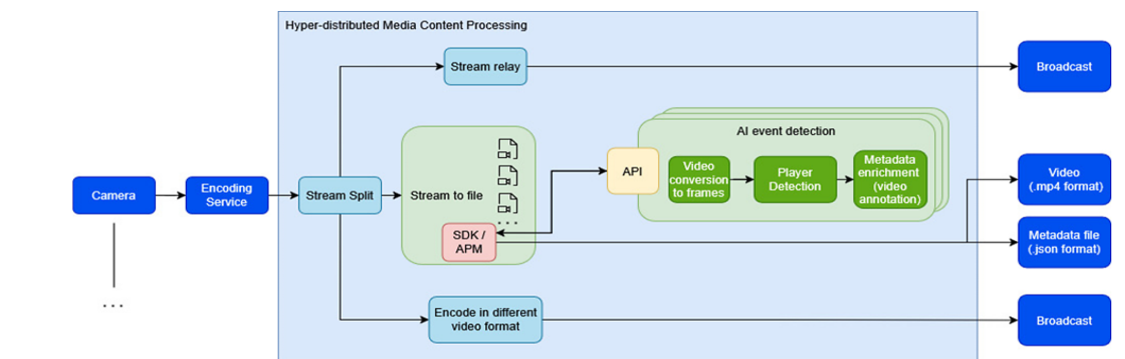
High-level architecture of the hyper-distributed media processing pipeline.
What ENACT adds behind the scenes
The media workflow is valuable on its own, but ENACT turns it into a system that can become observable, adaptable and easier to operate across a heterogeneous computing environment. Several project components have a clear role:
- Zero-Touch Provisioning (ZTP) can discover and prepare additional machines with minimal operator intervention, which is useful when extra capacity is needed at short notice.
- The Telemetry Data Collector and Monitoring Engine (TDCME) gathers real-time information on CPU, memory, network behaviour and other operational metrics, helping detect degradation before it becomes a visible failure.
- The Dynamic Graph Modeller (DGM) gives operators a live view of the pipeline, its services and their relationships, making bottlenecks and abnormal behaviour easier to understand.
- The Orchestrator and AI layer are designed to distribute workloads, anticipate demand peaks and scale resources up or down as conditions change.
- The Application Policy Model provides the rules that guide deployment and optimization decisions.
- The Security Risk Modeller (SRM) identifies application assets through Kubernetes labels that specify their type, category and description. These labels cover the RTMP/HLS ingress service, stream orchestrator, FFmpeg transcoding jobs, metadata-extraction API and AI-inference jobs, enabling SRM to model their relationships and assess potential security risks.
In practical terms, this means that a high-profile match or a weekend with several simultaneous events does not have to be managed through fixed infrastructure sized for the worst-case scenario. The system can progressively move towards allocating resources when and where they are needed, while scaling back after the peak.
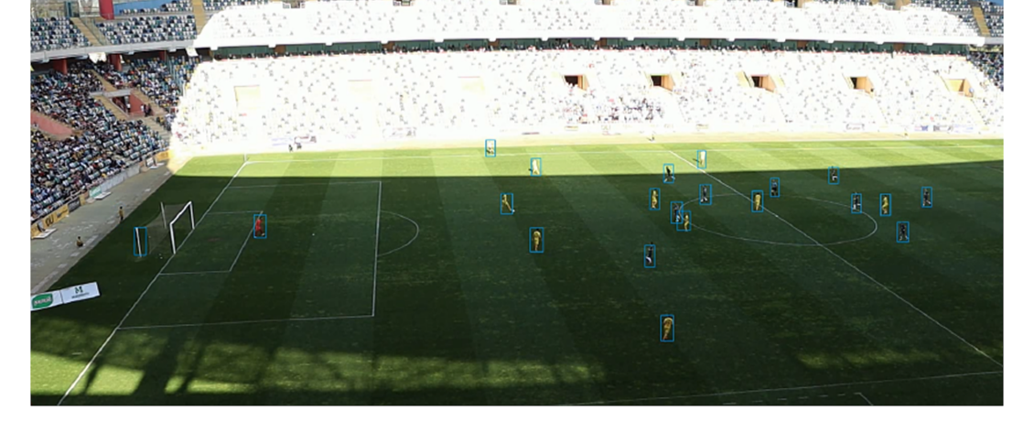
AI-based player-position detection generates structured metadata for every processed video segment.
What has been validated so far
The pilot has already moved beyond an architectural concept. Media and AI services have been deployed in both the ENACT experimentation environment and the MOG/EVS Kubernetes infrastructure. A pre-pilot test used a 45-minute football recording to verify the segmentation logic, the AI metadata API and the end-to-end processing sequence before the full workflow was containerized.
Initial integration tests have also confirmed that ZTP can discover a candidate machine and inspect its hardware and network configuration, while TDCME can detect and monitor the application pods running in the ENACT cluster. DGM displays graphs that visualize the streaming and AI components and the relationships between them. Dynamically created transcoding and inference jobs carry the EVS pilot identifier and use the ENACT orchestrator scheduler.
These are foundation tests rather than final performance results. Their importance lies in demonstrating that the pilot can be deployed, monitored and connected to ENACT services. With these building blocks in place, the next stage is to complete the KPI validation under realistic broadcast loads.
From technical targets to broadcast value
The validation framework is designed around outcomes that matter to both production teams and media businesses: reliability, efficient resource use, operating cost and processing throughput. The pilot will compare manual operation and the Kubernetes baseline with the ENACT-enabled environment under controlled failures, changing workloads and different numbers of concurrent live streams.
VALIDATION AMBITIONS
Target reduction in recovery time after a service, node, network or storage failure.
Target reduction in operational costs through automation and smarter edge-cloud allocation.
Target improvement in resource utilisation by reducing idle, statically allocated capacity.
Target increase in AI processing throughput, from a 44 fps baseline to at least 53 fps.
For broadcasters, the value is straightforward. Faster recovery means less risk of interruption. Better utilization means the same infrastructure can support more demanding events. Higher throughput allows more feeds or richer analysis to be processed without destabilizing the service. And automated deployment reduces the amount of specialist intervention required during a live production.
A path towards a more adaptive broadcast
The next stage is to complete the KPI validation of the full media pipeline using the integrated ENACT components under realistic football broadcasting conditions. The tests will assess reliability and recovery, resource utilization, operational cost and AI-processing throughput under controlled failures and changing numbers of concurrent live streams. The results will identify the improvements required to strengthen ENACT-based monitoring, scheduling and adaptation across the edge-cloud continuum.
The result is not simply a faster analytics service. It is a new operating model for live media: one in which the infrastructure can respond to the event with the same immediacy expected from the production team. The cameras keep capturing, the broadcast keeps moving, and the computing environment adapts in the background.