
In an edge-to-cloud continuum, monitoring is not simply an operational add-on. It is the foundation on which orchestration, adaptation, troubleshooting and trust are built. When workloads move across heterogeneous nodes, edge devices, clusters and cloud resources, the platform needs to understand what is happening before it can decide what to do next. This is the space where the ENACT Telemetry Data Collector & Monitoring Engine, or TDCME, becomes especially relevant.
TDCME has been developed to address a very concrete problem: monitoring across the compute continuum is often fragmented, heavy, and difficult to adapt to low-power or distributed environments. Existing solutions may provide powerful telemetry functions, but they are not always well suited to edge-cloud settings where bandwidth, locality, device capacity and automation requirements matter. ENACT’s approach is different. TDCME is designed as a lightweight, multi-layered monitoring component capable of collecting metrics from infrastructure, containers, network layers and application behaviour while remaining usable across constrained environments.
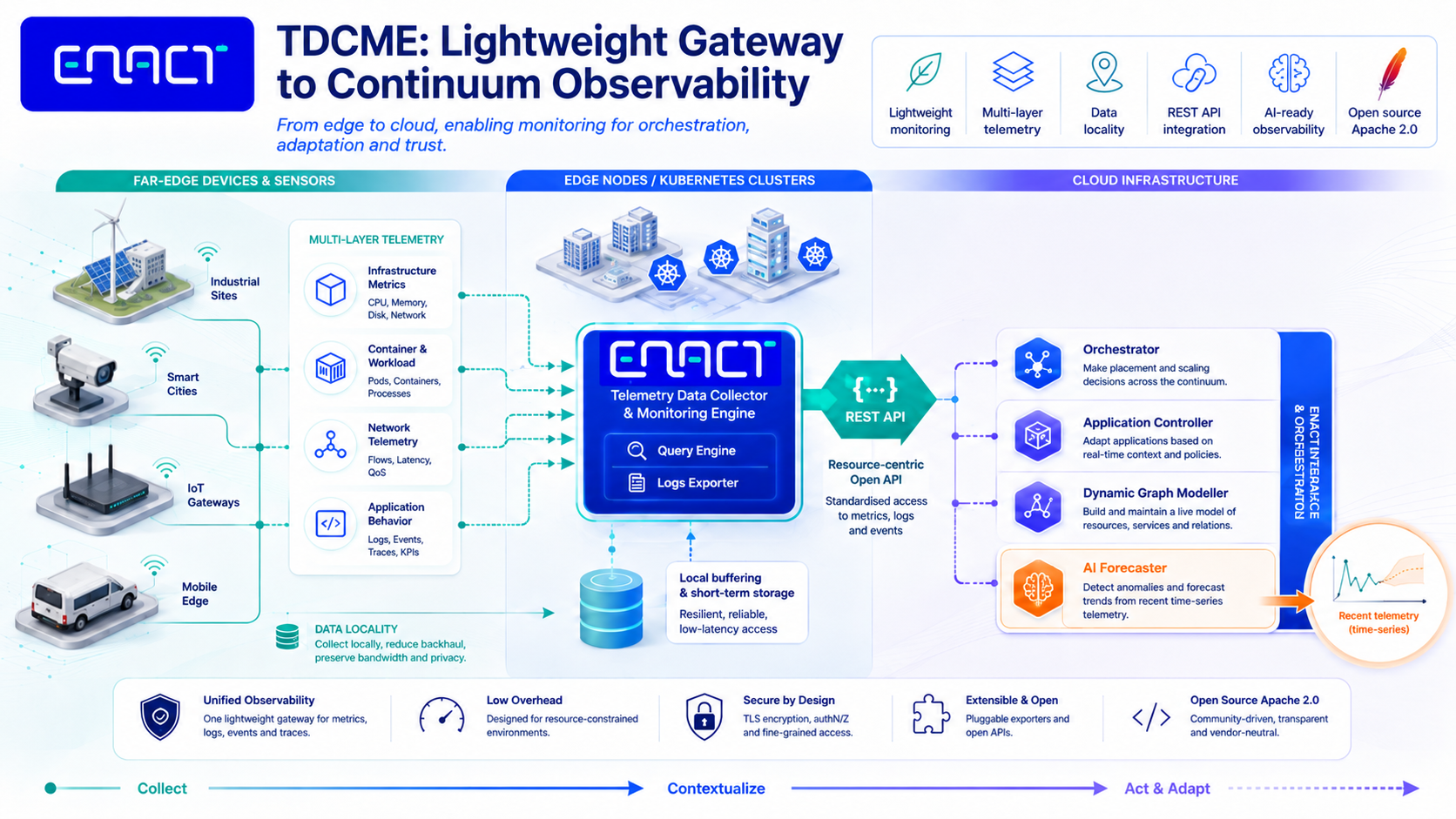
This is why TDCME is being positioned as a Key Exploitable Result. Its value is not only technical; it is practical. It exposes collected metrics through a resource-centric REST API, making it easier for orchestration tools and other ENACT services to consume telemetry. TDCME provides telemetry that can support the Orchestrator, the Application Controller, the Dynamic Graph Modeller and the AI Forecaster. Ιts connection with the AI Forecaster is particularly important because it enables the retrieval of recent infrastructure telemetry for anomaly detection and forecasting. Instead of relying only on stored historical data, the AI Forecaster can request the latest time-series data when it needs to assess the state of infrastructure nodes. This does not only make the intelligence layer more responsive to dynamic changes, but also enables keeping track of continuum states in order to predict near-future states and proactively schedule workloads to avoid performance bottlenecks ., TDCME also supports locality of data, meaning that data can remain close to its source, reducing unnecessary traffic and avoiding excessive bandwidth consumption at far-edge sites.
From an exploitation perspective, TDCME is attractive because its potential users are easy to imagine. Cloud and telecom providers, cloud-native application developers, edge infrastructure operators and organizations experimenting with Multi-Access Edge Computing can all benefit from a monitoring component that is lighter, more continuum-aware and easier to integrate with orchestration services. Its validation in ENACT testbeds and pilots, together with its open-source positioning under the Apache 2.0 licence, strengthens its potential for reuse beyond the project.
In this sense, TDCME is a good example of how ENACT is turning a technical building block into a concrete exploitation opportunity. It brings observability to distributed environments, supports energy-aware and AI-assisted orchestration, and offers a practical entry point for services that need to understand and manage the continuum so that they can optimize it.