
As artificial intelligence becomes more deeply embedded in digital services, infrastructure and decision-making processes, regulatory compliance is no longer a final checkpoint at the end of development. It is becoming part of how trustworthy AI systems are designed, assessed and prepared for deployment. This is why the ENACT AI Act Compliance Checker has become one of the project results that most clearly connects technical innovation with a fast-evolving European policy landscape.
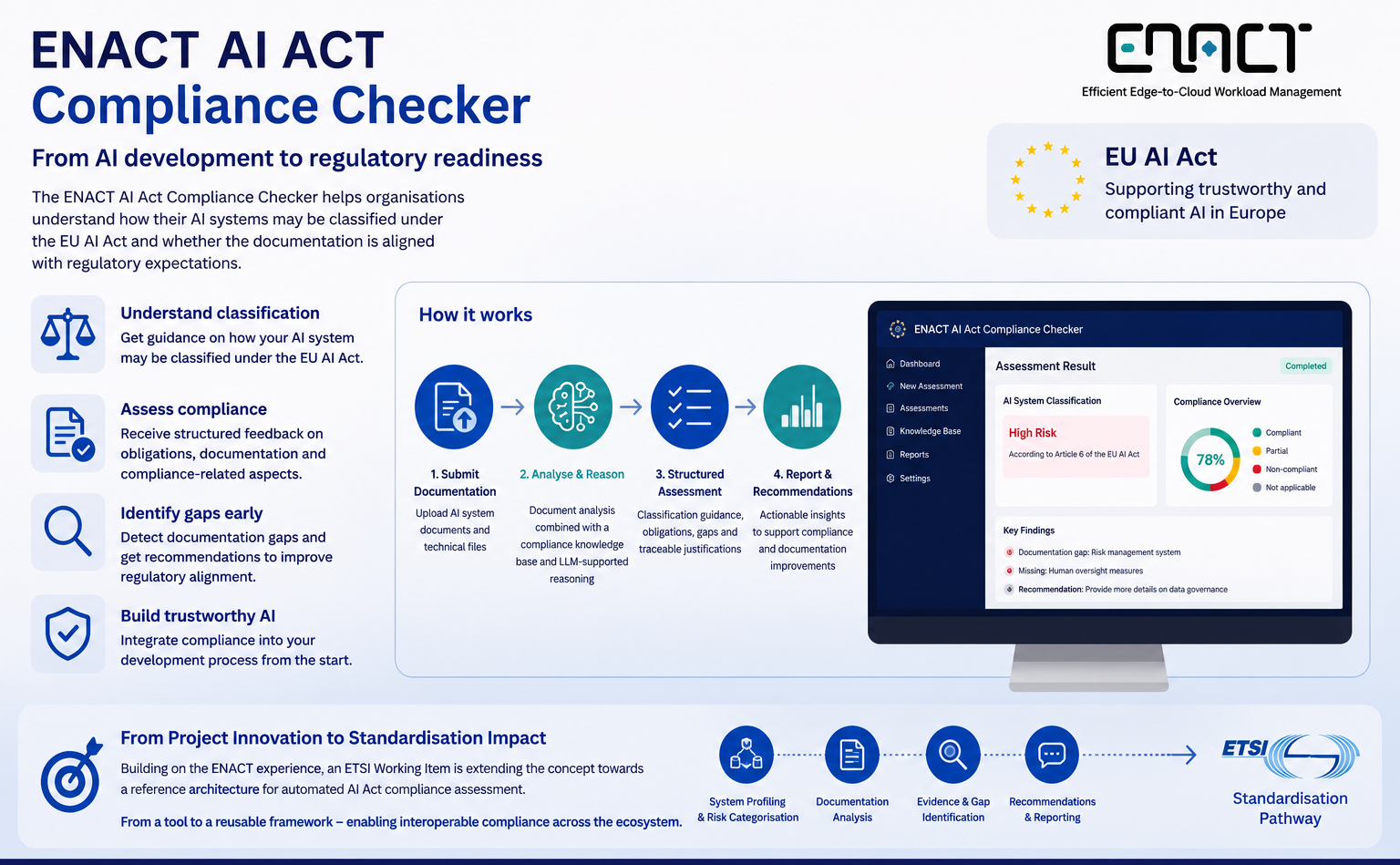
Developed within ENACT, the AI Act Compliance Checker supports users in understanding how an AI system may be classified under the EU AI Act and whether the available documentation is aligned with the corresponding regulatory expectations. Instead of leaving teams to interpret complex legal provisions on their own, the tool helps transform regulatory requirements into a more structured and actionable assessment process.
At a practical level, the Checker allows users to submit AI system documentation and receive structured feedback on classification and compliance-related aspects. Its workflow combines document analysis, a compliance knowledge base and LLM-supported reasoning to help identify relevant obligations, documentation gaps and traceable justifications. This makes the tool especially useful for developers, providers, compliance officers and organizations that need to assess regulatory alignment early, before AI systems move closer to operational deployment.
What makes this result particularly relevant from an exploitation perspective is that its value goes beyond the internal ENACT architecture. The AI Act is now a central topic for European digital innovation, and initiatives working with AI are increasingly expected to demonstrate how trust, accountability and legal alignment are being addressed. In this context, the Compliance Checker provides ENACT with a clear and timely contribution: a practical tool that helps bridge the gap between AI development and regulatory readiness.
This pathway is now being further reinforced through standardization. Building on the knowledge gained within ENACT, a Working Item that extends the AI Act Compliance Checker towards a broader multi-agent reference architecture for automated AI Act compliance assessment has been accepted by the ETSI standardization body and is currently being prepared. While the ENACT tool demonstrates how compliance checking can be implemented in practice, the standardization activity aims to generalize this experience into a more comprehensive and interoperable approach.
At a high level, the direction is to move from a single tool towards a structured compliance assessment framework, where different AI agents can support system profiling, risk categorization, documentation analysis, evidence collection, gap identification, recommendations and reporting. This evolution reflects an important exploitation route for ENACT: the project is not only producing software results, but also contributing knowledge and architectural thinking to European standardization discussions. This activity contributes also to the sustainability of results beyond the project lifetime.
For ENACT, this is strategically important. Standardization helps increase the visibility, credibility and potential uptake of project results beyond the consortium. It also shows how research outputs can influence broader ecosystems, especially in areas where regulation, trust and technology are converging rapidly.
The AI Act Compliance Checker therefore represents more than a supporting component. It is a concrete example of how ENACT is turning regulatory complexity into actionable intelligence, while opening a pathway from project innovation to standardization impact.