
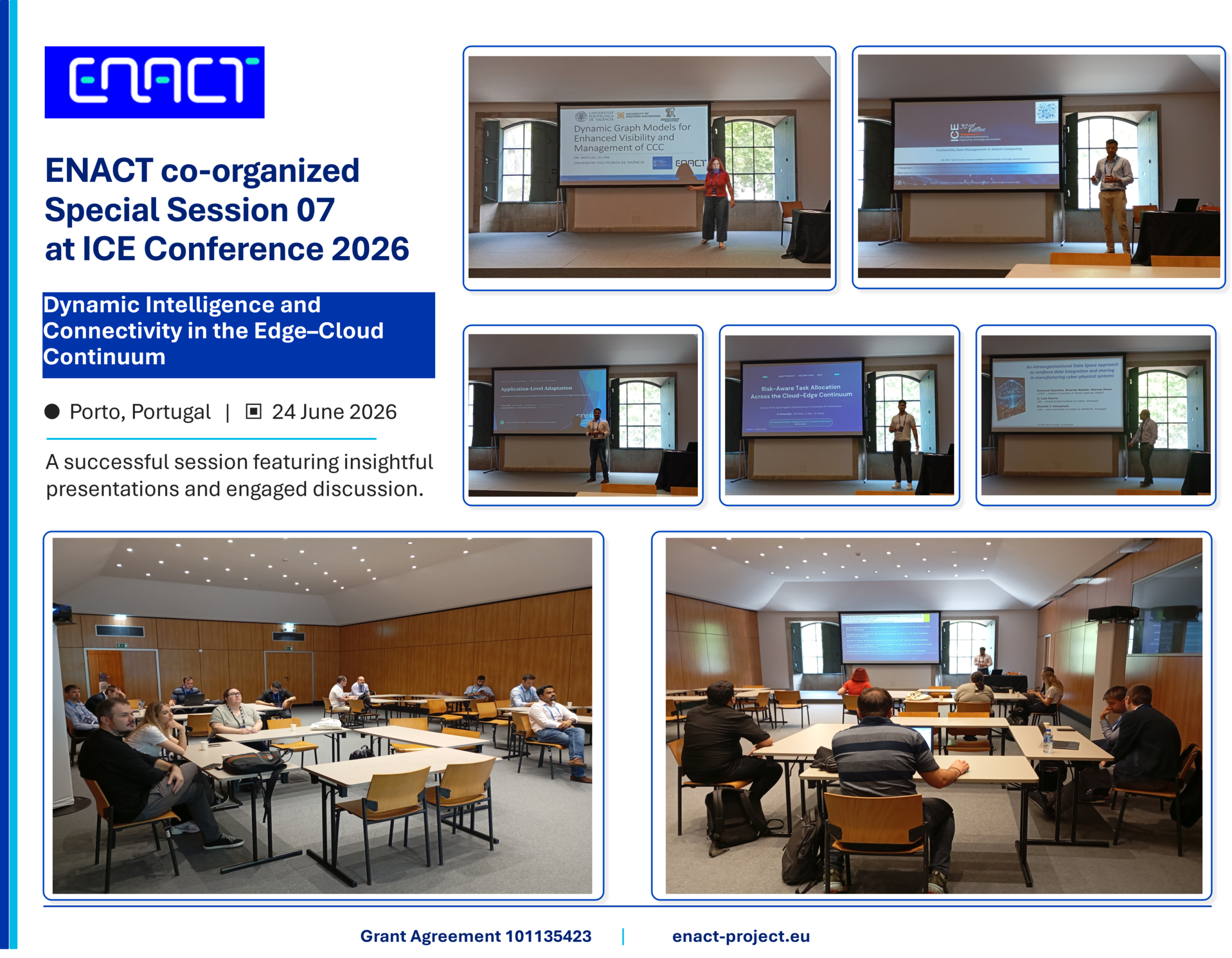
On June 24th, ENACT was pleased to co-organize Special Session 07: “Dynamic Intelligence and Connectivity in the Edge-Cloud Continuum” at ICE Conference 2026, held in Porto, Portugal. The session was organized as part of the conference programme under the joint chairing of Usman Wajid and Alexandros Nizamis, bringing together researchers, technology providers and innovation stakeholders working on the future of distributed intelligence across cloud, edge and IoT environments.
The special session provided a highly relevant setting to connect ENACT’s research agenda with broader scientific discussions on the Cognitive Computing Continuum. As digital infrastructures become more distributed, dynamic and data-intensive, the ability to observe, orchestrate, secure and adapt systems across heterogeneous environments is becoming essential. In this context, the session offered a timely opportunity to explore how advanced AI, data management, software engineering and orchestration approaches can support more intelligent and trustworthy edge-cloud systems.
Across the two parts of the session, participants presented a strong set of state-of-the-art contributions covering several complementary dimensions of the edge-cloud continuum. The first block included presentations on decentralized full-state estimation, gossip-based reputation mechanisms for robust swarm intelligence, simulation-aware distributed application development, operator skill development through telemetry-based training, and association-based continuum federation. These contributions highlighted the importance of combining scalable state representation, predictive orchestration, resilience mechanisms and federated resource management to support next-generation distributed computing ecosystems.
The second block continued the discussion with papers addressing dynamic graph models for improved visibility and management of the Cognitive Computing Continuum, trustworthy data management in swarm computing, application-level adaptation for more responsive distributed applications, risk-aware task allocation across the cloud-edge continuum, and data space approaches for manufacturing cyber-physical systems. Together, these works reinforced a key message for ENACT: future continuum platforms will need to combine technical performance with trust, governance, interoperability and operational adaptability.
ENACT would like to thank all speakers for their valuable presentations and for contributing to the success of the session: their contributions brought diverse perspectives from research, industry and applied innovation, helping to position the session as a meaningful forum for exchange around the scientific and technological challenges addressed by ENACT.
Beyond the technical presentations, the session also created space for engaged discussion and knowledge exchange. Participants explored how observability, runtime adaptation, trustworthy data flows, risk-aware AI and data spaces can be integrated into practical solutions for complex distributed environments. These conversations were particularly valuable for ENACT, as they confirmed the relevance of the project’s work and opened opportunities to connect its results with related initiatives, research communities and emerging technological needs.
Several important conclusions emerged from the session. First, effective management of the cloud-edge continuum requires richer and more dynamic representations of infrastructure, applications and data flows. Second, intelligence must be embedded not only in orchestration mechanisms, but also in applications, monitoring layers and trust models. Third, the future of distributed systems will depend on interoperable, governable and reusable architectures that can operate across organizational and technological boundaries. These conclusions are closely aligned with ENACT’s mission to advance a trustworthy and cognitive continuum for the deployment and operation of hyper-distributed applications.
ENACT would like to express its sincere thanks to the ICE Conference 2026 organisers for enabling the project to co-organize this special session and for providing such a valuable platform for scientific exchange. The project also thanks all authors, presenters and attendees for their active participation and for making the session a successful and productive event.
Through this participation, ENACT continues to strengthen its visibility within relevant scientific and innovation communities, while contributing to ongoing discussions on AI-enabled orchestration, trustworthy data management, adaptive applications and edge-cloud interoperability. The Special Session 07 at ICE Conference 2026 confirmed the growing importance of these topics and provided renewed momentum for the project’s work in the Cognitive Computing Continuum landscape.