
In a distributed computing environment, one of the biggest challenges is not simply deploying applications across edge and cloud resources, but actually understanding what is happening across that infrastructure at any given moment. Systems become increasingly difficult to interpret when resources are heterogeneous, workloads move dynamically, and multiple components interact continuously. This is precisely the problem addressed by ENACT’s Dynamic Graph Modeller (DGM), a core component designed to turn the Cognitive Computing Continuum into something that is not only operational, but also visible, intelligible, and actionable.
At its core, the DGM provides a real-time graph-based representation of the ENACT environment. Instead of showing the continuum as a collection of isolated logs, dashboards, or infrastructure lists, it models the system as a living graph in which resources, services, applications, and their relationships can be visualized together. This gives users a much richer understanding of how the continuum is structured and how it behaves over time. In practical terms, the DGM captures key relationships between components, services, and metrics, and keeps that representation updated as the system evolves.
What makes this especially valuable is the DGM’s position within the ENACT architecture. It acts as a bridging component between the Orchestration, Modelling, and AI layers. It collects real-time metrics and application data from the Orchestration layer, transforms that information into a dynamic graph, and makes it available to other ENACT components that need a structured view of the system. In this sense, the DGM is not only a visualization tool. It is also an enabling mechanism for more advanced platform intelligence. Components such as the Security Risk Modeller (SRM) and the AI Forecaster can consume this graph to support analysis, risk assessment, prediction, and decision-making.
From a technological perspective, the DGM is composed of two main parts: a backend and a frontend. The backend is responsible for retrieving telemetry data, metrics, and contextual information from the orchestration layer and then constructing the graph that reflects the actual state of physical devices and deployed applications. It is implemented in Python, using FastAPI for the REST interface and NetworkX for graph generation and manipulation. This backend does the essential translation work: it turns raw infrastructure and telemetry data into a coherent graph structure that other components can understand and use.
The frontend, meanwhile, is what makes the DGM accessible to human users. Developed in TypeScript with React, it provides the graphical interface through which users can explore the continuum. For the graph visualization itself, the component uses Sigma.js, a library specifically suited to interactive graph rendering. The frontend is not limited to one single view. Instead, it offers several complementary ways of inspecting the system, including views for cluster nodes, pods, application distribution across nodes, SRM report visualisation, and even an AI graph visualisation showing input and output graphs after processing by the AI layer.
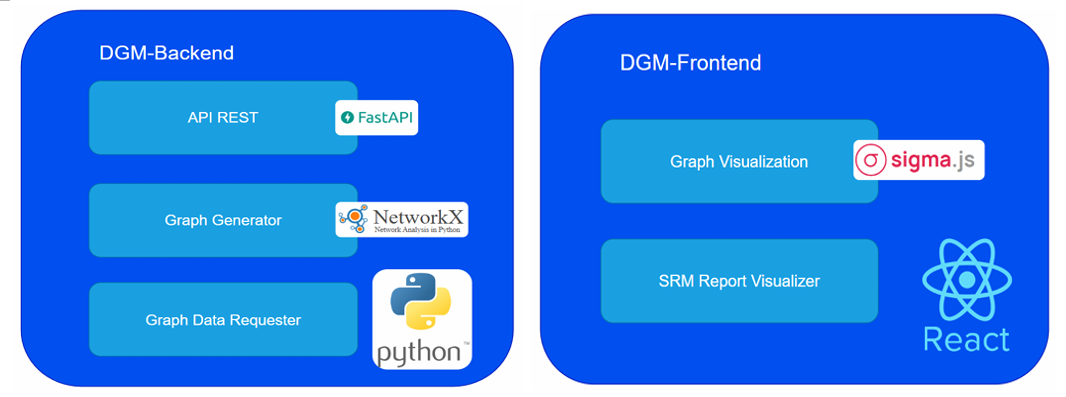
DGM backend and frontend implementation
This is where the DGM becomes especially compelling from a user perspective. It is not just displaying infrastructure: it is supporting situational awareness. Users can inspect how applications are distributed, understand which pods are connected, identify relevant metrics, and explore the topology of the deployment environment in a more intuitive way than conventional monitoring tools usually allow. The DGM was conceived with usability in mind, including support for zooming, panning, filtering, interactive graph manipulation, and an overall user-friendly visualization approach. The intention is that users should be able to determine at a glance whether an application is behaving correctly and how it is distributed across available resources.
Another important strength of the DGM is that it supports more than visual inspection alone. Because the graph is exposed through APIs and data interfaces, it can be consumed programmatically by other ENACT modules. This enables several high-value use cases, such as:
- AI-based optimization, where AI components traverse the graph to improve resource allocation or anticipate future states
- Intent-based orchestration, where orchestration modules use graph knowledge to make better deployment decisions
- Policy compliance and security analysis, including the detection of anomalous connections or unauthorized dependencies
- Root cause analysis, helping trace failures or performance issues back to their origin
Thus, the DGM gives ENACT that crucial visibility layer. It translates complexity into structure, structure into insight, and insight into better human and machine decisions. In that sense, it is not merely a supporting interface, but a foundational component for making the continuum truly operational.