
In any complex digital platform, one of the biggest challenges is not only building powerful services, but making them usable by different kinds of developers. This is exactly the problem addressed by two closely connected ENACT components: the Application Programming Model (APM) and the Software Development Kit (SDK). Together, they form the main bridge between users and the ENACT Cognitive Computing Continuum, helping developers access, combine, and deploy platform capabilities in a way that is both structured and practical.
At the core of this relationship is the APM. The APM is designed as the programmatic backbone for accessing ENACT services. In practical terms, it provides a set of Java libraries that allow applications to interact with the platform’s internal components in a secure, controlled, and standardized way. Rather than exposing ENACT’s internal services openly and directly, the APM acts as a formal access layer. This is important because ENACT is not a simple monolithic platform: it is a hyper-distributed environment where multiple components, endpoints, and services must interact across the edge-to-cloud continuum. The APM ensures that this interaction happens through a defined and protected model rather than through fragmented or ad hoc connections.
A particularly relevant aspect of the APM is that it evolved significantly during development. Initially, it was conceived more as an internal set of active services deployed inside the ENACT environment. Over time, however, the approach shifted toward a more flexible and developer-friendly model: the APM became a collection of downloadable JAR libraries, published through Maven Central, that users can integrate into their own development environments. This was an important move because it aligned the component with common software engineering practices and made it easier to adopt in real projects. In other words, instead of forcing the user to work around a fixed internal architecture, ENACT moved toward a model in which developers can pull the libraries they need and use them directly.
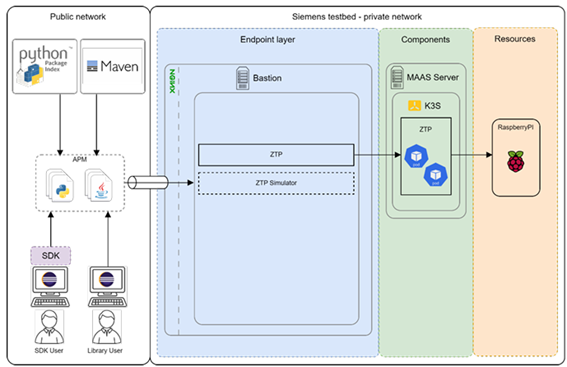
APM Deployment after paradigm shift
Still, the APM alone is not the whole story. While it offers powerful access to ENACT functionality, it is also relatively low-level and more suitable for users who are already comfortable with Java, Maven dependency management, and direct API interaction. This is where the SDK becomes essential. The SDK builds on top of the APM and turns its capabilities into something more approachable, more automated, and more adaptable to different levels of expertise.
The ENACT SDK has been intentionally designed in two complementary variants. The first is a library version, aimed at experienced developers. This version gives users a programmatic interface with higher-level abstractions than the raw APM calls. It reduces complexity by wrapping verbose interactions into simpler utility methods. A call that might require many parameters through the APM can be exposed through the SDK in a much more streamlined way, with defaults, context, or templates handling part of the work in the background. This improves productivity and reduces boilerplate.
The second variant is the Eclipse plugin version, which is especially valuable for users who prefer a graphical interface or who may not feel comfortable configuring everything manually. Instead of writing integration code from scratch, users can work through a guided environment embedded inside the IDE. This version supports service selection, code generation, configuration import, and method insertion directly into the user’s project. That makes the ENACT ecosystem much more accessible, especially for prototyping, collaborative development, or onboarding less experienced contributors.

SDK – APM Interaction
A key strength of the SDK is that it does not simply sit beside the APM but it is deeply tied to it. The SDK relies on conventions, templates, and standardized class structures so that the APM libraries can be discovered and managed automatically. This gives ENACT a scalable integration model. New services can be introduced without redesigning the entire toolchain, because the SDK can dynamically interpret component metadata and generate the necessary structures. This is supported by the template library and, in particular, by classes such as EnactComponentTemplate, which help standardize how components are described and invoked.
From a user perspective, the value of the SDK/APM combination can be summarized in three major contributions:
- Security and control: access to ENACT services is structured and mediated, not improvised.
- Developer flexibility: advanced users can work directly with libraries, while others can rely on guided tooling.
- Faster integration: code generation, templates, and reusable structures reduce manual effort and lower the entry barrier.
The SDK and APM show that ENACT is not only developing advanced platform components, but also thinking seriously about the developer experience. The APM provides the formal and secure access model; the SDK transforms that model into something easier to adopt in real workflows. Together, they make the Cognitive Computing Continuum practically usable.