
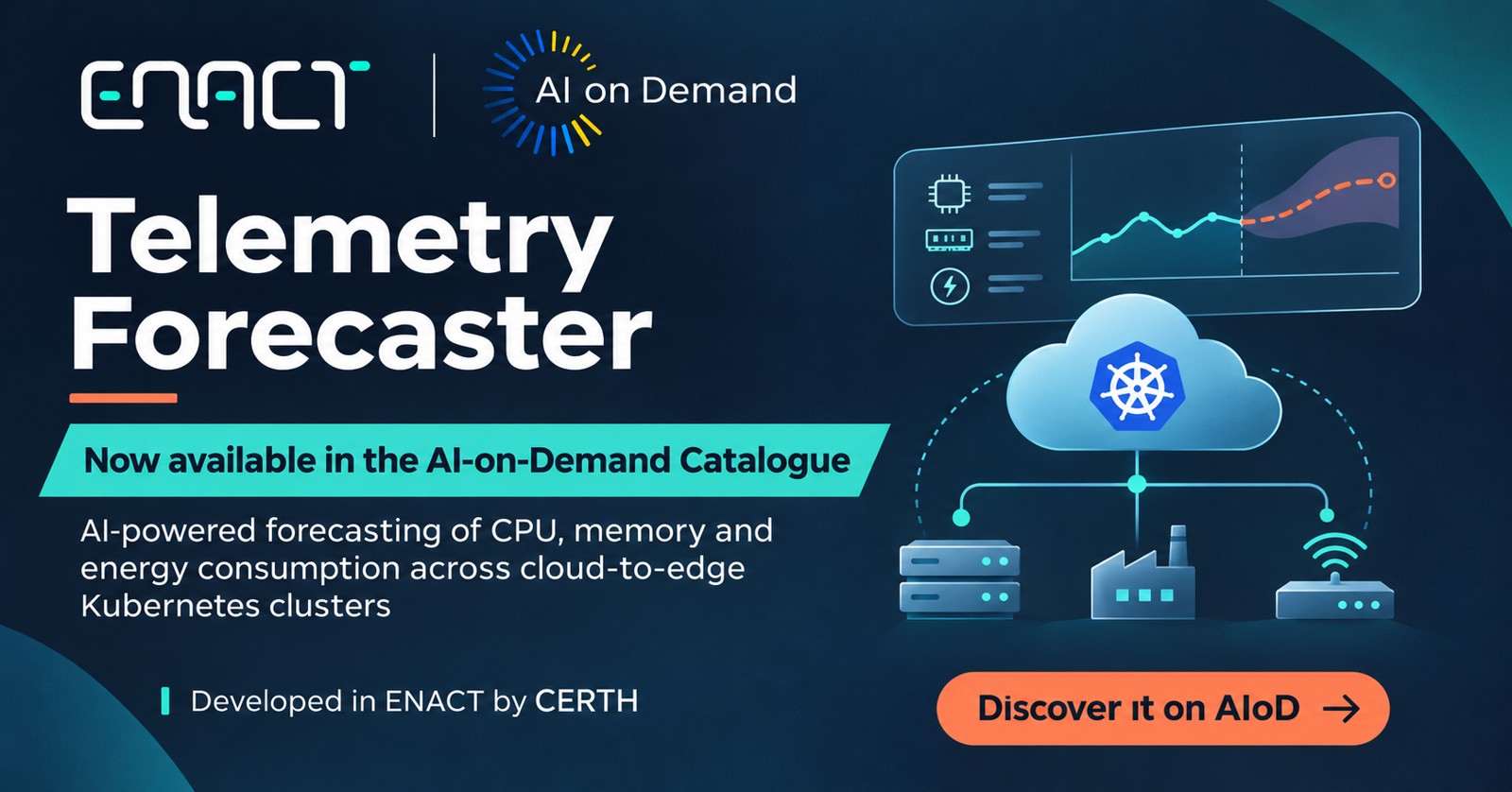
ENACT is pleased to announce that the Telemetry Forecaster, an AI-powered component developed by the Centre for Research & Technology Hellas (CERTH) within the project, has been published in the AI-on-Demand Platform (AIoD) Catalogue. The publication makes the component available for researchers, developers and technology innovators interested in predictive resource management across cloud and edge environments.
Managing distributed infrastructure requires continuous awareness of how computing resources are being used. In Kubernetes environments, changes in workload and resource demand can affect performance, capacity planning and energy consumption. While conventional monitoring provides information about current or past conditions, forecasting can help infrastructure management systems anticipate near-future demand and consider possible responses before resource constraints emerge.
The Telemetry Forecaster is designed for Kubernetes environments spanning cloud and edge infrastructure. It predicts near-future CPU utilization, memory utilization and power consumption for individual cluster nodes. By providing estimates of forthcoming resource conditions, the component can offer valuable information to systems responsible for scheduling, scaling and managing applications across heterogeneous computing resources.
A distinctive feature of the component is its spatio-temporal neural network, which captures relationships between cluster nodes rather than analysing each node in isolation. This approach takes into account how resource behaviour can be connected across an infrastructure, providing a basis for forecasts that reflect both temporal patterns and interactions among the monitored nodes.
The component also integrates Chronos-2, a time-series foundation model, to support predictions when unfamiliar nodes join the infrastructure. According to the component description, this integration enables forecasting for such nodes without requiring retraining. The capability is particularly relevant to dynamic environments in which the composition of a Kubernetes cluster may change over time.
These forecasting capabilities can support more informed orchestration decisions. Anticipated CPU and memory demand can be relevant to scheduling and scaling, while forecasts of power consumption can contribute to energy-aware resource management. The Telemetry Forecaster therefore adds a predictive perspective to the information available for operating cloud–edge systems, complementing approaches that respond only after conditions have changed.
For ENACT, the publication reflects the project’s broader objective of advancing the Cognitive Computing Continuum through more intelligent monitoring, orchestration and adaptation. Predictive telemetry is one of the capabilities that can help distributed platforms become more aware of their operating conditions and better equipped to manage changing infrastructure requirements.
The Telemetry Forecaster is released under the Apache License 2.0 and is featured in the AIoD Catalogue, where interested users can explore its technical specifications, interface and model resources. Making the component discoverable through AIoD helps connect the project’s research outputs with a wider community working on artificial intelligence and distributed computing.
ENACT invites developers, researchers and innovation stakeholders to explore the Telemetry Forecaster and consider its potential applications in predictive cloud–edge management. Its inclusion in the AI-on-Demand Platform represents another step in bringing ENACT’s technical results closer to those seeking practical tools for smarter, more adaptable and energy-aware digital infrastructure.
Further information: Explore the Telemetry Forecaster in the AIoD Catalogue