
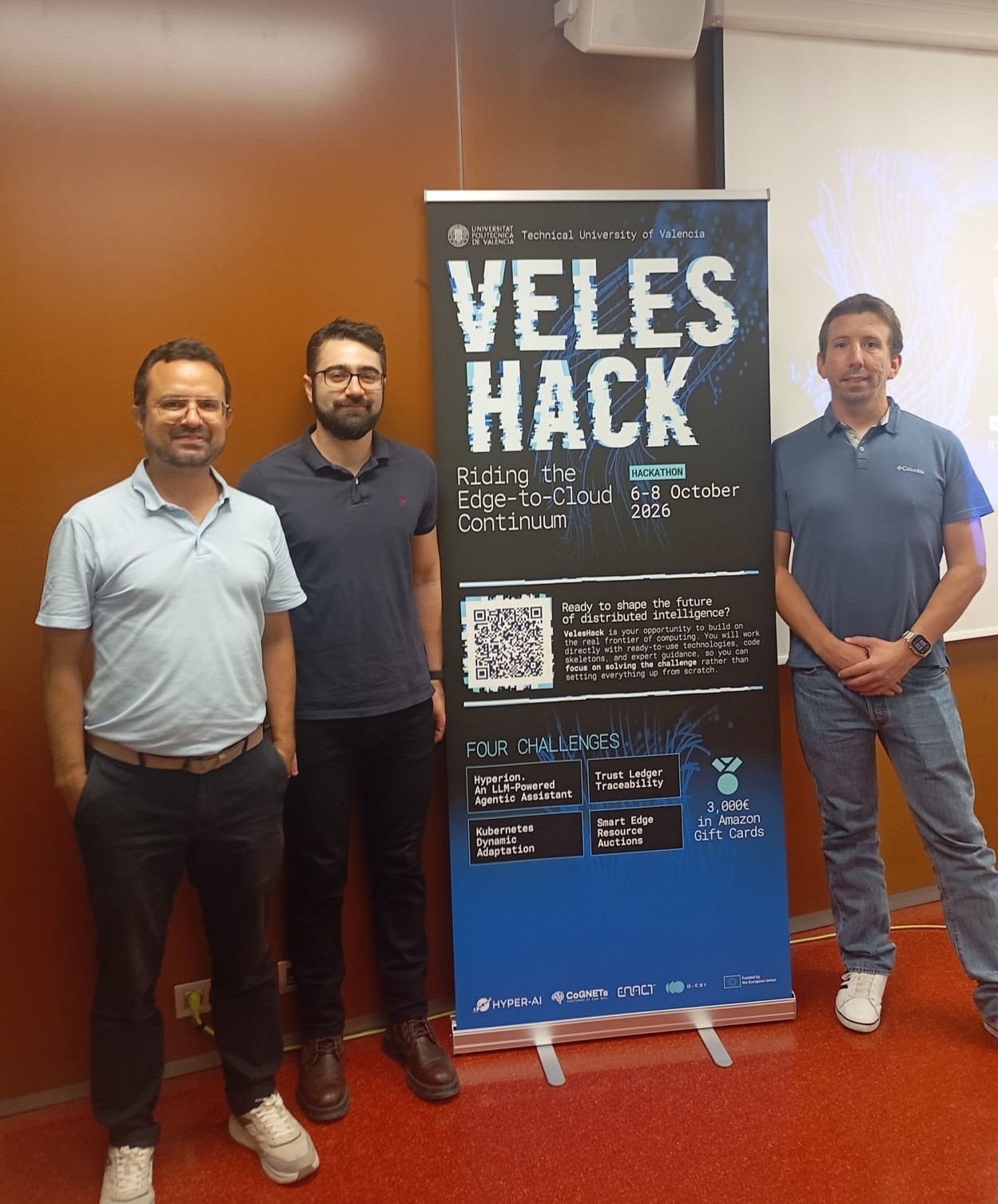
VelesHack 2026, from 6 to 8 October in Valencia (Spain), concluded with 53 participants developing 38 projects, bringing together practical experimentation and technical collaboration around the Edge-to-Cloud Continuum. The wider registration pool included people from 29 countries across Europe, Asia, Africa and the Americas, reflecting the international interest in the event and the challenges addressed by the participating teams.
The hackathon was a joint initiative involving ENACT, CoGNETs, HYPER AI Project and O-CEI Horizon, with the Eclipse Foundation coordinating the event. The Polytechnic University of València (UPV) hosted the hackathon and provided the infrastructure that also enabled remote participation. Throughout the event, participants worked individually and in teams to transform technical ideas into functional solutions, testing approaches and overcoming implementation challenges along the way.
The programme covered four technological challenges and encouraged experimentation with agentic AI, distributed trust, adaptive Kubernetes applications and dynamic edge-resource allocation. Rather than focusing only on theoretical proposals, participants were asked to develop approaches that could be implemented, demonstrated and explained in response to concrete technical needs. This practical orientation was an important element of the hackathon’s contribution to the wider continuum computing community.
ENACT contributed the Kubernetes Dynamic Adaptation challenge, which invited teams to develop and deploy an application within the ENACT Cognitive Computing Continuum (CCC) and make it respond intelligently to changing runtime conditions. The challenge placed application adaptability at the centre of the exercise, exploring how distributed Kubernetes environments can use real-time information and policies to manage workloads more effectively.
To address this challenge, participants worked with resources including the ENACT SDK, carbon-intensity information from the ENACT data space, runtime policies and the Application Controller. These elements allowed teams to investigate the relationship between application behaviour, resource allocation and environmental conditions, and to explore how decisions taken during operation can influence the efficiency of distributed services.
The winning team in the ENACT challenge was Carbonaut, representing the Netherlands, with a carbon-aware solution designed to direct electric-vehicle drivers towards the greenest available charging option. Sunflower, from Canada, was named runner-up for an approach that moves a running application towards cleaner computing resources without interrupting requests. The two solutions addressed different aspects of the challenge while sharing the objective of making the computing continuum more responsive to context and resource conditions.
Across the four challenges, each winning entry received a €500 Amazon Gift Card, while each runner-up was awarded a €250 Amazon Gift Card. Beyond the awards, the solutions demonstrated how participants could combine experimental freedom with concrete software components to explore resource adaptation, energy awareness and the practical use of emerging continuum technologies.
The event also created an important learning environment for students. Paula García Martínez, Arnau García Taberner and Rodrigo Losa Bessia, fourth-year students in Digital and Multimedia Technology at UPV, shared how the hackathon helped them apply knowledge from their studies, explore unfamiliar technical areas and understand the links between European research projects and practical technological development. Their experience highlighted the value of hands-on collaboration and problem-solving beyond the classroom.
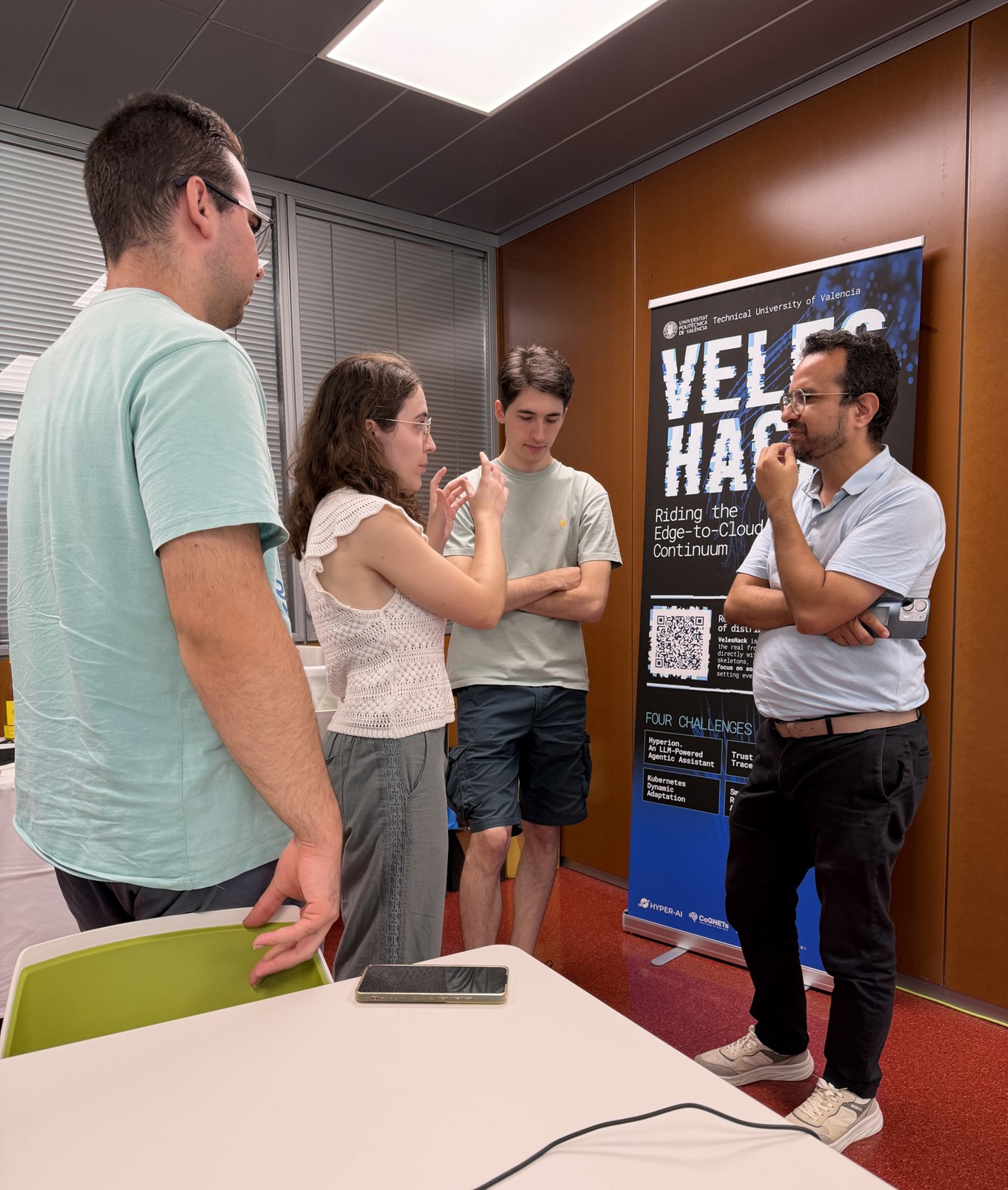
A key contribution to the ENACT challenge came from Athanasios Liatifis from the University of Western Macedonia, who supported the participants as a mentor. Access to project resources, guidance and a defined technical problem helped teams concentrate on experimentation and development rather than beginning entirely from scratch.
ENACT would like to thank its fellow co-organizers, the Eclipse Foundation, UPV, the mentors and everyone who took part in VelesHack 2026. The hackathon offered an opportunity to test ideas in realistic technical conditions and to connect new talent with European research on the Cognitive Computing Continuum. The results illustrated how adaptive, context-aware and more efficient cloud–edge applications can emerge from collaboration between research initiatives and developers.