

On September 13th, ENACT successfully completed the live validation of Use Case 2 during the Bandera de La Concha in Donostia-San Sebastián, marking an important milestone in the project’s final validation phase. The iconic rowing event provided a real-world environment in which ENACT technologies could be tested under the demanding conditions of a live public event, where service continuity, responsiveness and coordination across distributed digital components are essential.
Use Case 2 explores how ENACT can support a richer and more adaptive digital experience around the Regata de la Concha. As presented ahead of the event by EITB, the pilot brings together low-latency multimedia broadcasting, user participation and interaction, a real-time 3D environment of the race, and intelligent management of the technological resources supporting the service. The objective is not simply to deliver digital content, but to assess whether the underlying infrastructure can adapt to changing operating conditions while preserving performance and continuity.
The live validation showed a very positive overall outcome after months of integration, technical preparation and coordination among the partners involved. The live broadcast operated correctly throughout the validation, while the connection and integration between the UC2 platform and ENACT performed as expected in the live environment.
Two stress tests were also executed during the validation. Both showed positive preliminary behaviour, providing valuable evidence on how the system responds when conditions change and additional pressure is introduced. The detailed technical results are now being analyzed in depth as part of the post-event assessment, but the initial observations confirm that the integrated system behaved consistently during the planned validation activities.
A particularly relevant result was the successful completion of the adaptation loop. During the tests, ENACT responded correctly to the observed conditions and generated reconfiguration recommendations. These recommendations were received and executed by DataMiner, demonstrating the end-to-end connection between system observation, decision support and the execution of adaptation actions.
The validation also reached the KPIs planned for the live event. This represents an important step in demonstrating ENACT’s capacity to support distributed applications in situations where demand, latency and continuity requirements can evolve dynamically. At the same time, the team collected extensive technical evidence, including monitoring information, photographs and video material, which will support the detailed analysis of the validation and the consolidation of the final results.
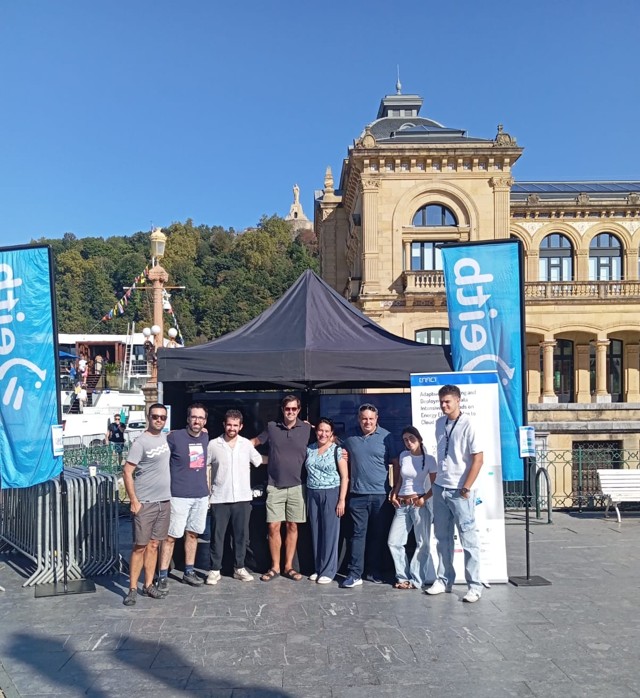
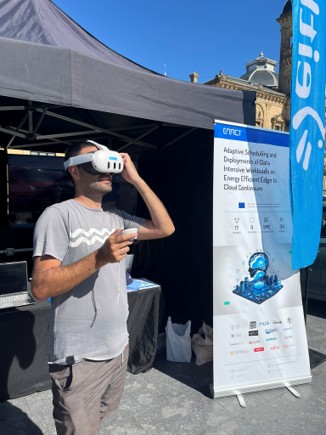
The pilot was not limited to technical validation behind the scenes. ENACT was also demonstrated in Donostia-San Sebastián during the event, giving visitors the opportunity to discover the experience first-hand, interact with the platform and explore how live media, 3D visualization and audience participation can be combined within a more responsive digital environment.
Testing ENACT during the Bandera de La Concha is especially significant because live events offer conditions that are difficult to reproduce completely in the laboratory. Audience behaviour can change rapidly, key moments cannot be repeated, and several digital services must remain coordinated while the underlying infrastructure is under pressure. Bringing the pilot into this environment therefore provides valuable evidence of how ENACT can move from technical integration towards practical operation in a complex real-world scenario.
The successful validation was made possible through close collaboration between EITB, Osoigo, Innovalia Association, Arctur and the Centre for Research & Technology Hellas (CERTH). ENACT would like to thank all the teams involved for their work throughout the preparation and execution of the pilot, as well as everyone who visited the demonstration in Donostia-San Sebastián or followed the experience online.
With the live validation now completed, the next step is to analyze the collected results in greater detail and assess the behaviour of the system across the different technical indicators and validation scenarios. The evidence gathered during the Bandera de La Concha will contribute to the final evaluation of Use Case 2 and to a broader understanding of how cognitive edge-to-cloud technologies can support more resilient, efficient and adaptive digital services for large-scale live events.
The Bandera de La Concha validation represents another important step in ENACT’s journey from research and integration to real-world demonstration, showing how the Cognitive Computing Continuum can help distributed services observe changing conditions, respond intelligently and maintain a reliable experience when it matters most.