
For a research platform to have impact beyond the consortium, it must become usable by people who were not involved in building it. This is especially true for developer-facing results. A powerful component can remain invisible if it is difficult to install, difficult to understand, or disconnected from the tools developers already use. The ENACT Software Development Kit, now available as an Eclipse plugin through the Eclipse Marketplace, marks an important step in addressing this challenge.
The SDK is one of ENACT’s most relevant exploitation assets because it acts as the developer gateway to the Cognitive Computing Continuum. Its purpose is to help users to make actual use of ENACT services from within a familiar development environment, reducing the friction normally associated with complex distributed platforms. Instead of requiring developers to manually understand every internal service, API and deployment mechanism, the SDK organizes key functions into a unified Eclipse Control Panel.
The current SDK structure is organized around three main modules. The Dataspaces module allows developers to work with data space operations from the IDE, including assets, policies, contracts, catalogue browsing, negotiations and transfers. The Application Packaging module supports the preparation of deployment artefacts, helping applications move toward Kubernetes-based execution across the continuum. The AI Assistant module introduces local support through Ollama, allowing developers to receive LLM-assisted help while keeping the interaction tied to a local runtime.
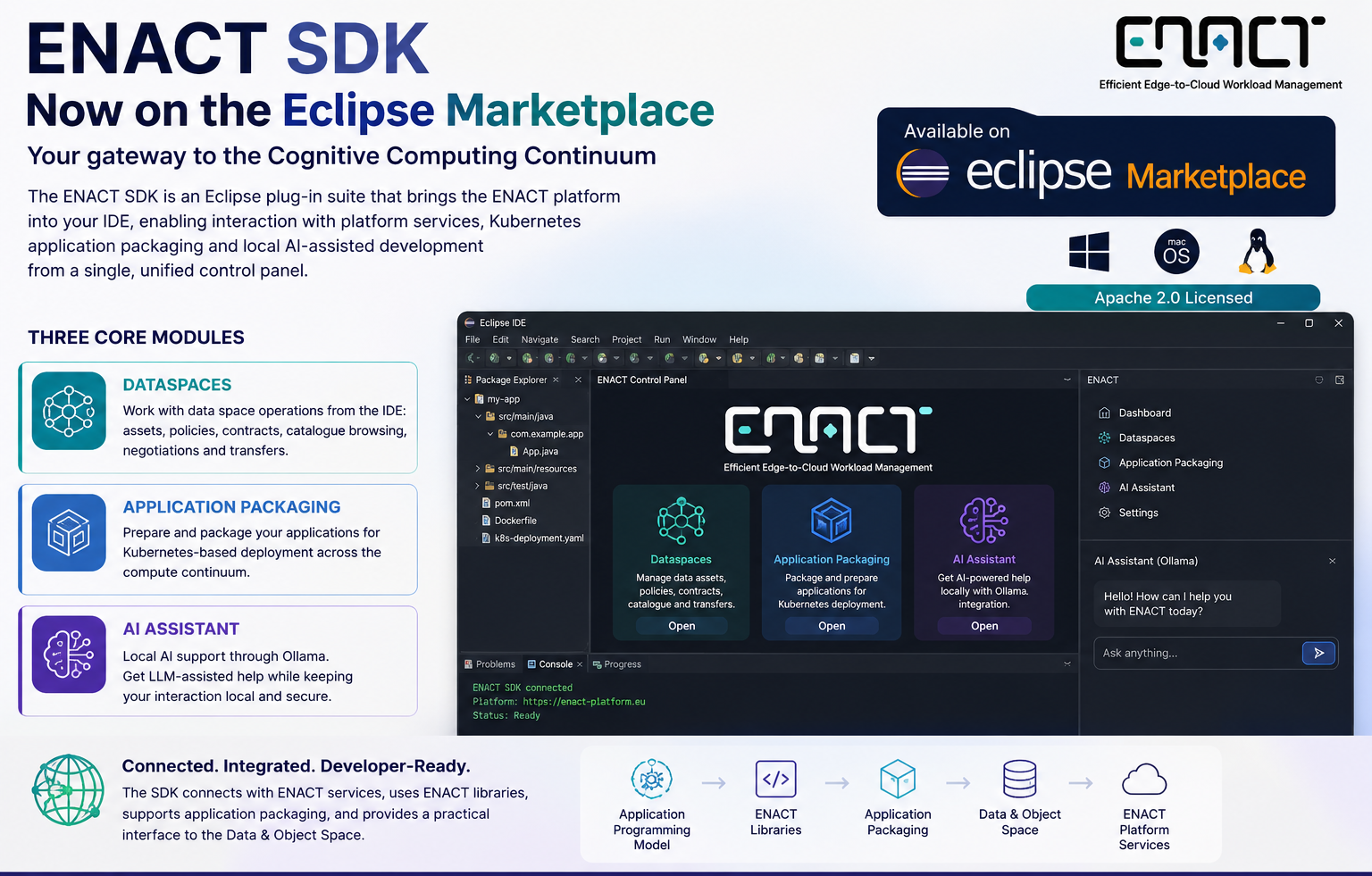
The Eclipse Marketplace publication is significant because it changes the nature of the result. The SDK is no longer only a project-internal tool or a technical deliverable. It becomes a visible, installable and recognizable plugin in one of the most established open-source developer ecosystems. The listing presents the SDK as an Eclipse plug-in suite that brings the ENACT platform into the IDE, supporting Kubernetes application packaging and local AI-assisted development from a single control panel. It also identifies the plugin as Apache 2.0 licensed and available for the main desktop platforms supported by Eclipse.
This is important for exploitation because adoption often depends on small practical details: where the tool is found, how it is installed, whether it fits existing workflows, and whether it feels credible to external users.
The SDK also strengthens the exploitation of other ENACT results. It is integrated with the Application Programming Model to directly use ENACT libraries, supports application packaging, and provides a practical interface to the Data & Object Space. In that sense, it is not an isolated KER. It is a gateway through which other ENACT capabilities can become more accessible to developers.
The exploitation message is clear: ENACT is not only producing backend technologies for orchestration and continuum management. It is also creating the tools needed to make those technologies usable. The SDK’s release as an Eclipse plugin is a key milestone for the project since it provides a concrete step from research output toward developer adoption and long-term reuse.