
One of ENACT’s most important ambitions is not only to build a powerful Cognitive Computing Continuum (CCC), but to make that continuum usable, understandable, and accessible for real users. In practice, this means giving pilots, developers, and infrastructure teams the ability to deploy, connect, monitor, and optimize distributed applications across edge, fog, and cloud environments without having to master all the underlying complexity. That is precisely where ENACT’s user interfaces come in.
At this stage of the project, ENACT presents a set of interfaces and supporting tools that act as the visible and practical layer of the platform. Rather than exposing users directly to the full internal machinery of orchestration, telemetry processing, optimization logic, and policy enforcement, these interfaces translate that complexity into workflows that are much easier to handle.
The three central elements highlighted in this first overview are:
- the ENACT Software Development Kit (SDK),
- the Zero-Touch Provisioning (ZTP) services,
- and the Dynamic Graph Modeller (DGM) graphical interface.
Each of them addresses a different challenge in the onboarding and operation of hyper-distributed applications.
The SDK is mainly oriented toward developers and system integrators. Its role is to help them prepare applications so they can operate correctly within the ENACT environment. The SDK includes an OSGi-based Eclipse plugin with code-generation capabilities that automatically creates ENACT-compliant project structures. It is also tightly connected to the Application Programming Model (APM), which gives access to core ENACT libraries and services. This combination is especially important because it reduces development friction: instead of building everything from scratch, users can rely on templates, guided structures, and direct access to the functions needed to interact with the platform.
Beyond coding assistance, the SDK also includes a dataspace-facing interface connected to the ENACT Data & Object Space. This allows users to discover offers, negotiate contracts, and retrieve digital assets such as deployment artefacts, including Kubernetes manifests and configuration files. This is a very relevant feature because it shows that ENACT is not treating application development as an isolated task. Instead, it is linking development, deployment, and data exchange into a more integrated experience.
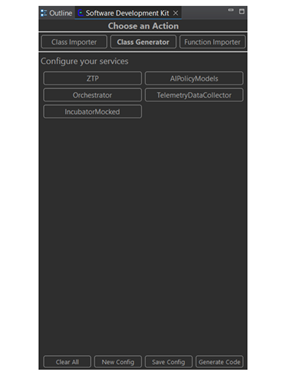
SDK interface to ENACT Services
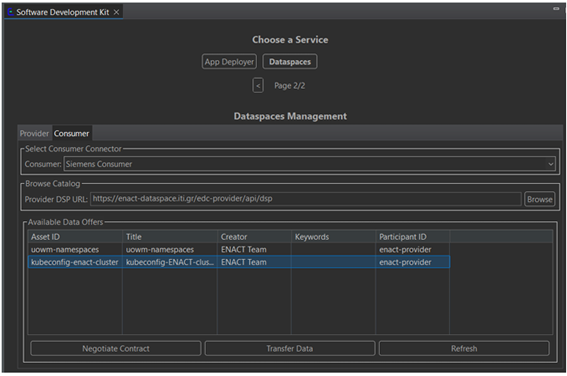
Interface for ENACT Data & Object Space in ENACT SDK
Alongside the SDK, ENACT provides Zero-Touch Provisioning (ZTP) services. If the SDK simplifies how applications are prepared, ZTP simplifies how infrastructure is attached to the continuum. Its purpose is to automate the discovery and onboarding of devices across the edge-cloud environment, including both bare-metal and virtual machines. This is particularly valuable for pilots that already have their own clusters or edge nodes and do not want to migrate everything from scratch. Through ZTP, they can connect their own infrastructure to ENACT with minimal configuration effort, and then benefit from the broader orchestration and optimization services of the platform.
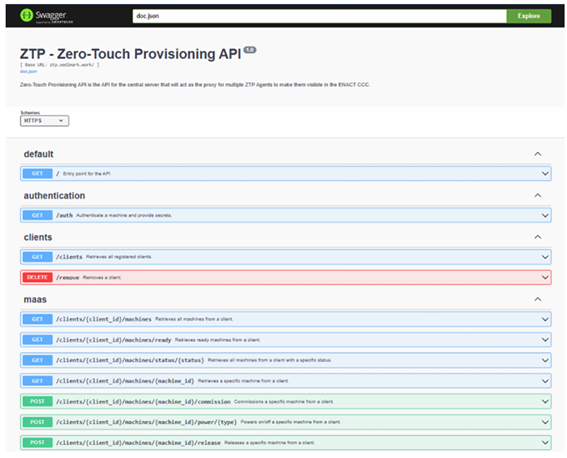
OpenAPI endpoints for using the ZTP server
The third interface, and perhaps the most visually intuitive one, is the Dynamic Graph Modeller (DGM). The DGM gives users a dynamic, graph-based representation of the continuum, almost like a digital twin of the deployment environment. It visualizes nodes, interconnections, and deployed components based on real-time information, allowing users to observe application behavior, infrastructure status, and operational metrics in a much more immediate way. This matters because distributed systems can quickly become difficult to understand when they span many heterogeneous resources. A graph view provides a far more comprehensible way to inspect what is happening across the system.
Importantly, the DGM is not just a monitoring dashboard. Its role in ENACT is broader: it acts as a bridge between the operational state of the infrastructure and higher-level reasoning components, supporting visibility, decision-making, and interaction with AI and orchestration layers. It also integrates a risk-assessment view, where users can inspect potential cybersecurity or compliance issues identified by the Security Risk Modeller. This means the interface supports not only observability, but also more trustworthy and informed operation of the continuum.
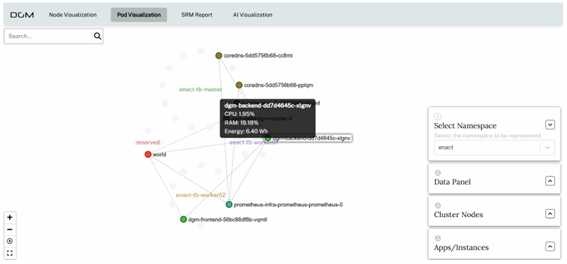
Figure 4. Representation of the connections of a selected pod in the DGM UI
Taken together, these interfaces show something very important about ENACT’s approach. The project is not only building advanced components for orchestration, optimization, and monitoring but it is also ensuring that those components become practically usable by real stakeholders. The SDK accelerates development, ZTP lowers the barrier to infrastructure onboarding, and DGM makes the state of the continuum visible and actionable. The result is a more coherent and approachable user experience in which the complexity of the underlying platform is still there, but is no longer a burden for the end user.