
At the heart of ENACT’s vision for a scalable, intelligent, and hyper-distributed digital ecosystem lies a foundational capability: Zero-Touch Provisioning (ZTP). As distributed applications grow in complexity and geographic diversity, manual device bootstrapping becomes a bottleneck: slow, error-prone, and incompatible with the automation demands of next-generation services. ZTP addresses this challenge by enabling fully automated discovery, configuration, and management of devices across the Cognitive Computing Continuum (CCC), ensuring seamless, secure, and adaptive deployment at scale.
A Core Enabler of ENACT’s Distributed Architecture
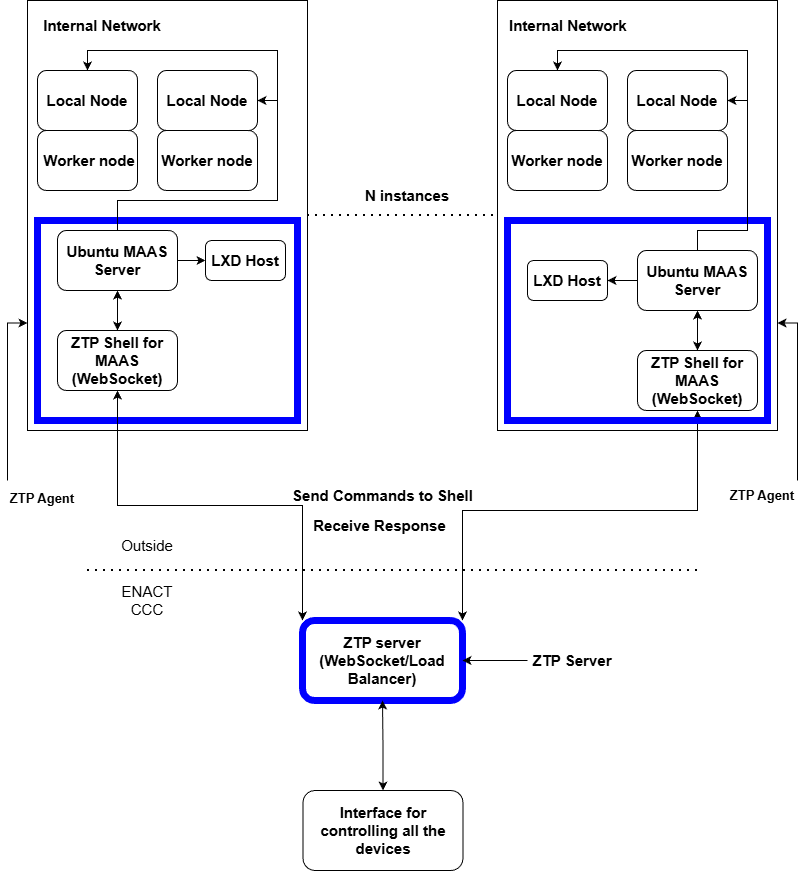
ZTP Architecture
ZTP is designed as a critical component of the ENACT CCC, offering the automation required to deploy hyper-distributed applications across networks that span edge devices, on-premise servers, and cloud environments. The system operates through a central ZTP Server and a distributed set of ZTP Agents, forming a decentralized architecture that supports dynamic resource allocation and real-time orchestration.
The ZTP Server maintains continuous communication with the Orchestrator, exchanging information on device availability, system health, and network characteristics. This interaction enables automated provisioning workflows: as new devices are discovered, the Orchestrator provides configuration parameters that the ZTP Server applies selectively to each target network. This ensures that deployments remain context-aware, secure, and aligned with application demands.
Automated Device Configuration and Monitoring
A defining feature of ENACT’s ZTP system is its automatic deployment of Kubernetes on the onboarded devices connecting the worker nodes to the ENACT CCC, which in turn deploys the Telemetry Data Collector and Monitoring Engine (TDCME) onto newly deployed worker node. Once deployed, TDCME captures key performance metrics, such as power consumption, pod performance, hardware utilization, CPU load, memory usage, and delivers them to ENACT’s data layer via the Orchestrator. These metrics feed the AI layer, allowing it to forecast resource needs and optimize workload placement across clusters.
To support flexible and consistent configuration, ZTP integrates templating for deployment definitions. This ensures that device configurations can be tailored to the application requirements while remaining centrally manageable through ENACT’s Data Storage, APM, and SDK layers.
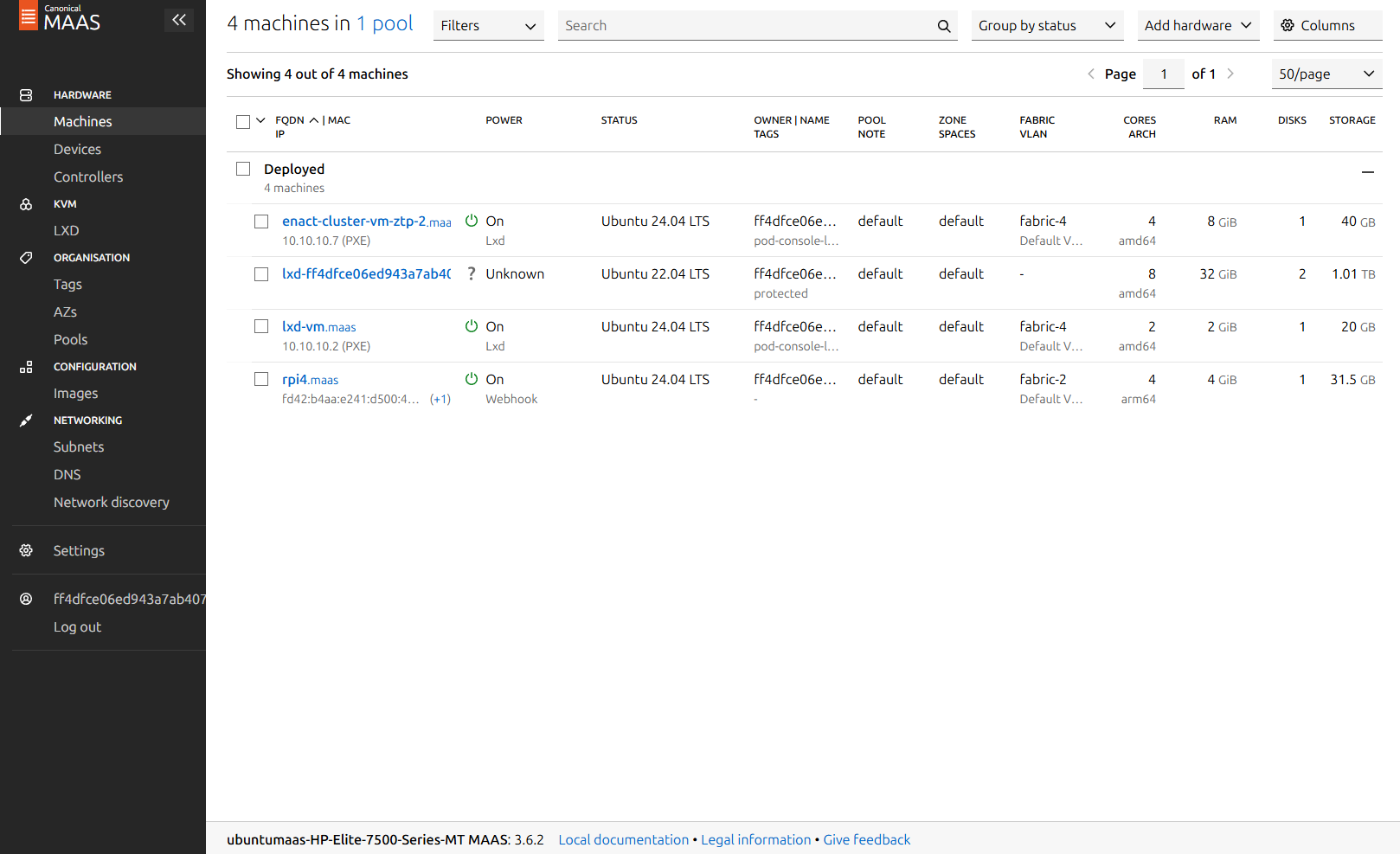
Ubuntu MAAS UI
A Secure, Standardized, and Scalable System
Security sits at the core of ZTP’s design. The system incorporates:
- Authentication endpoints to verify ZTP Agents.
- Authorization mechanisms to prevent unauthorized access.
- Persistent secure connections between ZTP Server and Agents.
ZTP Agents act as local proxies of the CCC within remote networks, interacting with MAAS for bare-metal provisioning and maintaining the communication backbone for distributed orchestration. Automated installation scripts further streamline MAAS setup, while a dedicated shell-like application enables reliable agent-server interaction.
To enable standardized cluster management, ZTP supports Kubernetes installation on onboarded devices and integrates Cilium or equivalent inter-cluster networking solutions. This ensures consistent communication and policy enforcement across multiple Kubernetes nodes and clusters. At deployment time, the system can select the optimal master node for worker node connections based on location, latency, and other factor, this being an essential requirement for ENACT’s distributed environment. Built-in failover mechanisms provide resilience, minimizing disruption without manual intervention, keeping the connection between the server and the agents always up and running.
Real-World Integration Across ENACT’s Pilot Use Cases
TP is not merely a theoretical capability: it is actively integrated and validated across all three ENACT pilot scenarios.
- Media Broadcasting – Hyper-Distributed Content Processing
In high-pressure environments such as live sports broadcasting, ZTP enables rapid, automated deployment of video processing components – metadata enrichment, player tracking, and broadcast enhancement – across edge nodes and cloud data centers. It allows rapid scaling, failover, and secure, consistent deployment, reducing operational overhead and ensuring real-time performance.
- Mobility – Fujitsu’s Digital Twin for Fleet Operations
For Fujitsu’s distributed digital-twin infrastructure, ZTP automates the provisioning of compute nodes using MAAS and Cloud-Init scripts, enabling instant rollout of regional processing environments. This supports low-latency data fusion, consistent configuration, and seamless Kubernetes-based application deployment via the Orchestrator.
- Public Sector – Cultural Heritage and Tourism Media Production
In large-scale events such as the La Concha Regatta, ZTP provisions distributed edge and cloud resources necessary for live streaming, VR content generation, and interactive user experiences. Its automated workflows allow the pilot to scale dynamically, maintain configuration integrity, and deliver robust, immersive services to broad audiences.
Zero-Touch Provisioning stands as a linchpin of the ENACT ecosystem, enabling automated device onboarding, intelligent resource allocation, and the rapid deployment of distributed applications. By integrating orchestration, telemetry, AI-driven optimization, and secure provisioning into a unified framework, ZTP provides the operational backbone required for Europe’s next generation of cognitive, trustworthy, and hyper-distributed digital services.